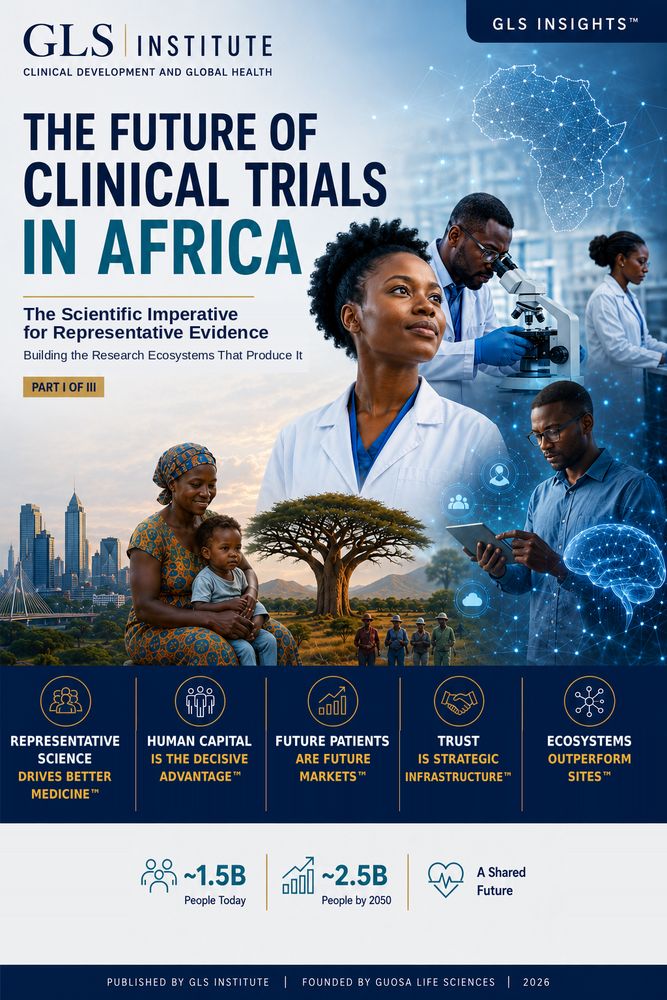
Part I: The Scientific Imperative
Why representative research matters, and the demographic and disease-burden case for it.
22 pages · PDF, 890 KB
Download
GLS Insights · Benchmark Series
Three parts, 64 pages, plus an executive brief and series companion.
Abstract
The most consequential shift in twenty-first-century healthcare is not technological. It is demographic. Africa is home to roughly 1.5 billion people, about 18 percent of the world’s population, and is projected to reach close to 2.5 billion by 2050, about one in four people on earth. The continent carries an estimated 25 percent of the global disease burden, yet hosts a fraction of the research that defines how the world’s medicines are developed and approved.
The scale of that gap is now measurable. Of the 20,825 trials that began globally in 2023, roughly 4 percent were hosted by African countries. This series examines what that gap costs, what is already changing, and what it would take to close it.
The central argument is that global clinical development is shifting from geography-driven networks to ecosystem-driven networks. Africa is one of the clearest examples of that transition, but the framework applies to every region. The future belongs not to isolated sites, but to connected ecosystems.
The series
Why representative research matters, and the demographic and disease-burden case for it.
22 pages · PDF, 890 KB
DownloadEcosystem maturity, regulatory convergence, and what actually determines study performance.
21 pages · PDF, 666 KB
DownloadHow AI, precision medicine, regulation, and manufacturing are redrawing global development.
21 pages · PDF, 701 KB
DownloadDownloads
All three parts in one volume
75 pages · PDF, 2120 KB
Download PDFThe argument in eight pages
8 pages · PDF, 495 KB
Download PDFFramework, indicators and counterarguments
14 pages · PDF, 499 KB
Download PDFKey findings
South Africa alone accounts for over 62 percent of continental trial activity. Central Africa, home to more than 180 million people, contributes under 3 percent. The problem is distribution, not the existence of capable institutions.
The African Medicines Agency is operational in Kigali, the harmonization program formally handed over at Lusaka in January 2026, and a WHO framework agreement was signed at the Seventy-ninth World Health Assembly in May 2026. Eight national authorities now hold WHO maturity level 3.
The 2025 contraction in external research funding put stipends and programs into acute precarity, and forced institutions to assume leadership faster than planned. An ecosystem that is scientifically capable can still be financially fragile.
Study performance is no longer determined primarily by selecting capable investigators and qualified sites. It is determined by regulatory collaboration, laboratory networks, referral pathways, digital readiness, workforce depth, community trust and supply-chain resilience.
Who this is for
Country selection, feasibility modeling and the operational assumptions that shape multi-country planning.
Benchmarking against the maturity model, and the evidence needed to be visible to sponsors.
Where investment changes trajectory, and which indicators to track over time.
Discuss the findings
Our team briefs sponsors, institutions and funders on the findings and what they mean for a specific program.