Full report
Version 1.0, 60 pages
60 pages · PDF, 859 KB
Download PDF
GLS Insights 2026-01
Closing the Phase I Capability Utilization Gap. 60 pages, with an executive brief.
Abstract
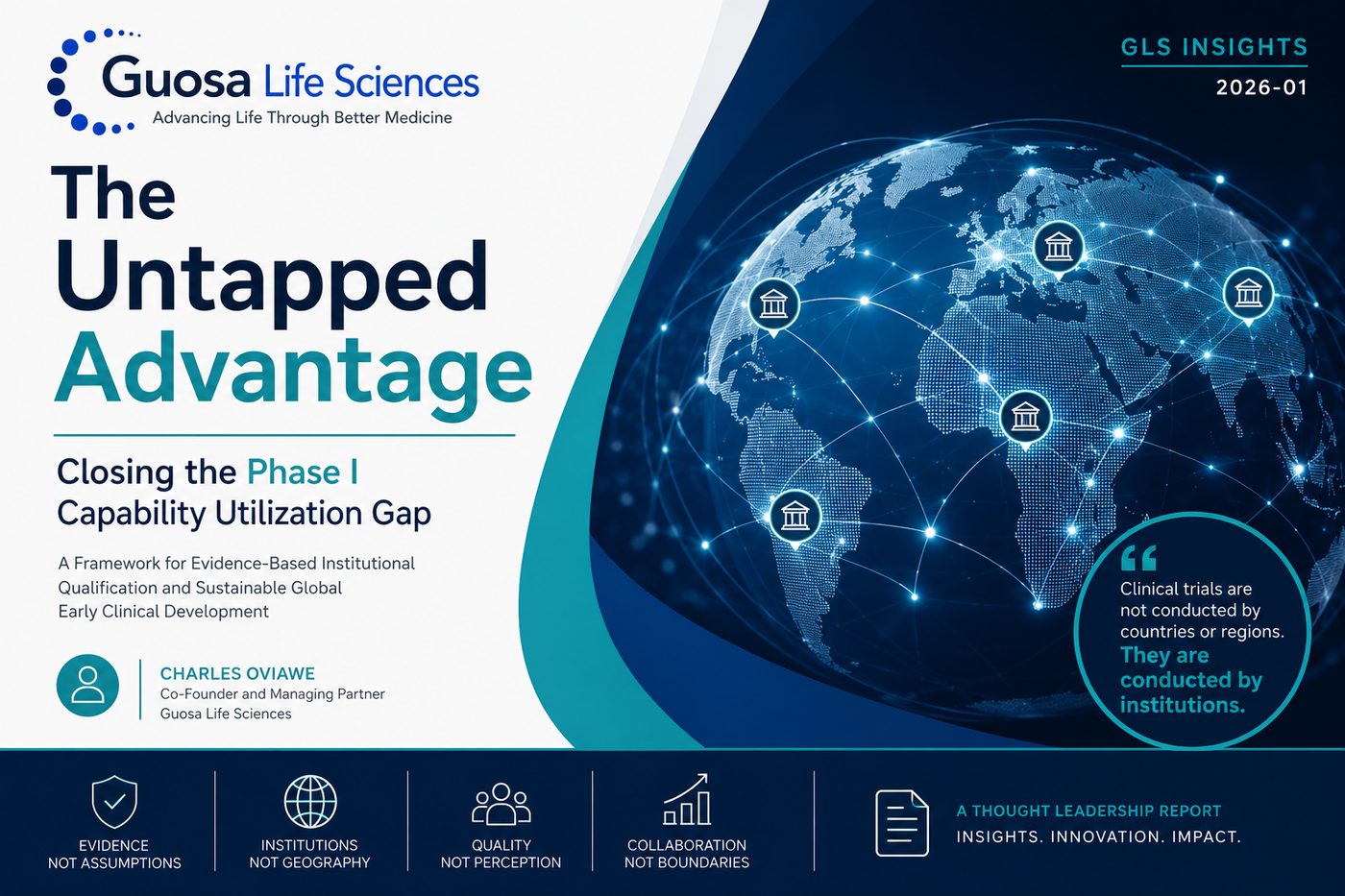
Clinical trials are not conducted by countries or regions. They are conducted by institutions: specific ones, with named investigators, a particular research infrastructure and a documented track record.
That distinction is the argument of this report. Between 1 and 4 percent of global clinical trials are hosted on the African continent, against roughly 19 percent of world population and 25 percent of global disease burden. The gap is routinely explained by capability deficits. The evidence points elsewhere, to limited visibility, lagging perception and information asymmetry.
The report examines the objections most often raised, including supply chain economics and bioanalytical capacity, and sets out a ten-stage framework for evidence-based institutional qualification: assessed institution by institution, evidenced rather than assumed.
By Charles Oviawe, Co-Founder and Managing Partner, Guosa Life Sciences.
Downloads
Version 1.0, 60 pages
60 pages · PDF, 859 KB
Download PDFThe argument in four pages
4 pages · PDF, 127 KB
Download PDFKey findings
WHO data records 845 of 76,331 trials initiated globally in 2023 as African-hosted, or 1.1 percent. IQVIA, using a narrower industry-initiated denominator, records 4 percent. The range reflects methodological differences in denominator and reporting, not uncertainty about the direction.
Establishing a country supply lane carries a fixed cost largely independent of shipment volume. That cost is real, but it applied with equal force to Central and Eastern Europe and Latin America before those regions became major contributors, and it is amortized across a portfolio rather than a single study.
Accredited bioanalytical capability operates and publishes to international standard, currently concentrated in vaccines and infectious disease. Samples are shipped elsewhere at higher cost while accredited local capability is bypassed: the utilization gap, documented in an adjacent domain.
The report sets out ten stages from strategic study planning through requalification, each producing the evidence required to support an objective qualification decision, allowing sponsors to identify strengths, recognize risks and define mitigation.
Who this is for
A structured basis for deciding which institutions can conduct a specific study, rather than which regions are assumed to be able to.
The domains, documentation and evidence that a sponsor assessment will examine.
Discuss the findings
Our team briefs sponsors, institutions and funders on the findings and what they mean for a specific program.